Posts

Nanotechnology + Art
Image
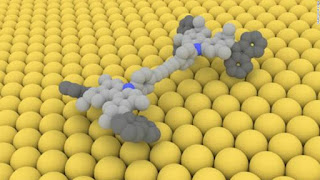
As our current society evolves, not only does the scale of our research and inventions grow but also decreases. Nanotechnology is the science at nanoscale and can change physical and chemical properties of elements (“What Is Nanotechnology?”). As the scientist dive into the nano world, they can create tiny worlds. An example of the artistic creation is by Professor Alex Zettl, who created the first world’s smallest synthetic motor, and James Tour, who made the first nano car without a motor shown below (“World’s Smallest ‘Electric Car’ Is Only the Size of a Molecule”). The total size of the car is only one molecule and is invisible to the human eye. As Professor Vesna and Professor Gimzewski mentioned during lecture, working at such a small-scale cause distortion in the common relationships of our world.   Such incredible feat is combination of art and nanotechnology.  Nano Car Of One Molecule Size Additionally, art allows the audience to better understand nanote...

Neuroscience + Art

Image
 Dreaming while sleeping As Professor Vesna has mentioned in lecture, the human brain is still a mystery to us. Despite the numerous research on dreams and how the mind works, we have yet to have conclusive fact on why we dream (Webmd). Artists have used this unknown factor as the basis for diverse movies and allows the audience to explore the possibility of the mind. An example is the movie, Inception, a neo-noir science fiction heist film about a thief who steals information by infiltrating the subconscious (IMDB). Dominick and Arthur are extractors of information and they enter a dream world where they can plant an idea in a person’s subconscious. The film writer and director of the movie explore the use of shared dreams and what dreams mean to us. Some neuroscientists believe that dreams reflect subconscious desires and mainly influence people’s decisions and attitudes (American Psychological Association). Inception uses this idea to show how once Dominick and Arthur im...

Biotech + Art

Image
Genetically Modifying Crop Biotechnology is a combination of art and technology. It is closely tied to genetically modified animals and crops. Although biotechnology brings advantages, it alters the DNA structure and changes the natural behavior of the animal and crop. Dolly, the first cloned sheep Genetically Modified Chicken compared to the past. For example, dolly was a female domestic sheep and it was the first to be cloned. Specifically, it is the first mammal cloned from an adult somatic cell using process of nuclear transfer. Dolly is an advancement in biotechnology as it opens the path towards cloning humans to transfer bodies or creating bodies for extra organs. It relates to art as scientists’ approach perfectly cloning mammals. However, reasons for genetically modifying mammals are not always for pure research. Currently, many famers genetically modify their chickens to lay more eggs and to gain weight in a shorter amount of time than regular chic...

Event 2

Image
For my second event, I attended the exhibition, “Cut! Paper Play in Contemporary Photography” at the Getty Center. The exhibition features work of artists who use paper as their main medium to deliver their messages.  Picture of Midnight Reykjavik by Soo Kim. The above image is of the work of Soo Kim, “Midnight Reykjavik #5”. This was my favorite piece as it uses two layers of paper cutout to represent the indoor of the homes. Usually when we take in an aerial view or a photo of a landscape, we are only able to see the roofs of the homes and never the inside. I found it interesting to see the cutouts that show the inside of the houses, a new perspective on the setting. Additionally, other artists at the exhibit use different methods to portray 3D by cutting out paper. The work by Christiane Feser, “Partition 31” was mesmerizing. The picture looks 3D; however, as shown on the right side of the above picture, its 3D nature is shown through cut outs of small squares ...

Midterm Link

https://drive.google.com/file/d/1T8yM5w0zFps3LWWElbAjtS2al0KVdFag/view?usp=sharing

Week 4 - Medicine & Art

Image
After reviewing Professor Vesna’s lecture regarding medical technologies and art, I agree that art and medicine cannot be separated. I was most intrigued about the play of art in plastic surgery. I did not realize that plastic surgery originated during the war. A soldier who had facial reconstruction after facial injury.  As BBC states, facial injuries would most likely occur due to shrapnel, causing the blast to rip a face off. It was only due to Harold Gillies that plastic surgery was developed and began facial reconstruction. Although initially, plastic surgery occurred to save lives, it is now considered cosmetic surgery.  Features that could be improved through cosmetic surgery. Coming from South Korea, where plastic surgery is prevalent, I automatically connect plastic surgery to aesthetic purposes. The general population in America associates cosmetic surgery to raising the nose bone or breast implants; however, in Korea, cosmetic surgery ranges...

Event 1

Image
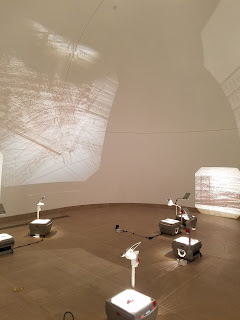
For my first event, I attended the Lawrence Abu Hamden exhibition at the Hammer Museum. Through use of audiovisual, Lawrence demonstrates the Syrian military prison north of Damascus. Most of the prisoners were blindfolded in their cell and Lawrence uses audiovisual to represent their experience.   Lawrence Abu Hamden exhibition setup. Picture of myself outside the exhibition in front of introductory panel. First, when I entered the space, it had a speaker on the side and a wall with jagged edged at the front. Behind the wall were projectors showing lines crisscrossing each other to demonstrate the precepted image of the prisoners through sound.  I found this exhibition very interesting as it closely relates to the math and art we have discussed and learned through Professor Vesna's video lecture. Lawrence uses the speakers and jagged wall to replicate the echoes in the prison. It utilizes diffusion, which causes the echo and disharmonious sound. On the ...